

In This Article
Somewhere around week thirty of pregnancy, most parents-to-be discover a strange new anxiety: bedding vocabulary. You go looking for something soft to keep in the nursery and suddenly you’re staring at listings for cot blankets, cot bed blankets, cellular blankets, and junior duvet sets, all of which sound interchangeable and none of which actually are. It’s a small thing to get wrong, but it’s also one of the few nursery purchases where “small thing” brushes up against genuine safety guidance, so it’s worth five minutes to get straight.

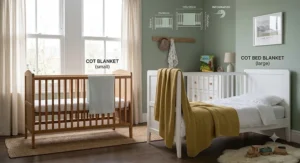
Here’s the short version: a cot blanket is typically the thin, breathable layer used with younger babies in a standard cot, sized to be tucked in firmly and used alongside safer sleep practice. A cot bed blanket usually refers to bedding scaled for the larger cot bed frame, and often includes bulkier options like duvets, which come with their own age restrictions. So what is cot bed blanket vs cot blanket really about? It’s less a battle of two products and more a question of which stage of your baby’s sleep journey you’re shopping for, and which safety guidance applies at that stage.
This guide compares seven genuinely available options, from a fiver-a-pop cellular blanket to an organic wool cot bed duvet for toddlers, alongside honest safety context so you know exactly which one suits your baby’s age. We’ll also cover cot bed blanket and pillowcase set options, receiving blankets, cot bed dimensions, and the cot to cot bed transition age parents ask about most. This article contains affiliate links, and as an Amazon Associate I may earn from qualifying purchases.
Quick Comparison Table
| Product | Type | Best Age | Price Range | Best For |
|---|---|---|---|---|
| Clair de Lune Soft Cotton Cellular Baby Blanket | Cellular blanket, 150x100cm | Newborn+ | around £10-£15 | Everyday cot and pram use |
| The Little Green Sheep Organic Knitted Cellular Baby Blanket | Organic cellular blanket, 75x75cm | Newborn+ | £18-£24 range | Premium newborn nursery kit |
| aden + anais essentials Cotton Muslin Blanket 4-Pack | Muslin receiving blanket, 112x112cm | Newborn+ | £25-£32 range | Multi-use swaddling and receiving |
| Clair de Lune Jungle Dream Reversible Cot Bed Duvet Cover and Pillowcase Set | Cot bed blanket and pillowcase set | 12 months+ | around £12-£18 | First cot bed duvet upgrade |
| The Little Green Sheep Organic Wool Cot Bed Duvet for Toddlers | Cot bed duvet, 120x140cm | 12 months+ | £45-£60 range | Premium natural-fibre toddler bedding |
| Bloomsbury Mill Cellular Blankets, Pack of 2 | Cellular blanket, 75x95cm | Newborn+ | £12-£16 range | Budget-friendly newborn essentials |
| Amazon Basics Reversible Microfibre Cot Bed Duvet Cover Set | Junior bedding set, 100x135cm | 12 months+ | around £10-£15 | Budget cot bed transition bundle |
Looking at the spread above, the real dividing line isn’t price — it’s age. Every cellular and muslin blanket here suits a newborn cot from day one, while the duvet-based cot bed blanket and pillowcase set options are firmly for the 12-months-and-over cot to cot bed transition age. If you’re kitting out a newborn nursery, start with the Clair de Lune Soft Cotton Cellular Baby Blanket or The Little Green Sheep Organic Knitted Cellular Baby Blanket. If you’re upgrading a toddler who’s just moved into a cot bed, the Clair de Lune Jungle Dream Reversible Cot Bed Duvet Cover and Pillowcase Set or the Amazon Basics Reversible Microfibre Cot Bed Duvet Cover Set make more sense.
💬 Just one click — help other make better buying decisions too!😊
Top 7 Cot and Cot Bed Blankets: Expert Analysis
1. Clair de Lune Soft Cotton Cellular Baby Blanket — the everyday all-rounder
The standout here is genuine versatility: at 150cm by 100cm, this cellular cotton blanket is generously sized for a standard cot yet light enough to double as a pram cover or car seat layer. Cellular construction — that grid of small holes woven through the fabric — isn’t just decorative; it traps pockets of air that help regulate temperature, keeping a baby warmer in winter and cooler in summer without the bulk of a solid weave. Based on the spec comparison with solid-knit blankets, that breathability matters more than most first-time parents expect, since overheating is a recognised risk factor in infant sleep.
Reviewers consistently highlight two things: the generous size, which leaves enough spare fabric to tuck securely under a cot mattress on both sides, and reliable colour retention after repeated washing, useful if you’re doing separate baby-only laundry loads. Manufactured in OEKO-TEX certified factories, it’s built to a recognised textile safety standard rather than just claiming to be “baby safe” on the label. One buyer specifically noted the blanket “isn’t too thick,” reassurance for parents wary of overheating risk.
This is the mat — sorry, blanket — to buy first for a newborn nursery, before you’ve settled into a routine or worked out exactly how many spares you’ll need.
Pros:
- ✅ Generously sized for tucking in securely on both sides
- ✅ OEKO-TEX certified breathable cotton construction
- ✅ Doubles as a pram or car seat blanket
Cons:
- ❌ Colour range limited compared with patterned alternatives
- ❌ Single-layer design offers less warmth than a doubled muslin
At around £10-£15, this is a sensible first buy for any newborn’s cot.
2. The Little Green Sheep Organic Knitted Cellular Baby Blanket — the organic premium pick
What most buyers overlook about “organic” labelling on baby textiles is that it isn’t just a marketing checkbox — certified organic cotton is grown without the synthetic pesticides used in conventional cotton farming, which matters directly for a fabric that sits against a newborn’s face for hours at a stretch. This 75cm by 75cm knitted cellular blanket from The Little Green Sheep, a brand that’s been making natural nursery bedding for two decades, leans into that promise with 100% certified organic cotton throughout.
The knitted cellular structure gently moulds around a baby’s body rather than sitting rigid, which several reviewers describe as noticeably softer than woven cellular alternatives. Aggregated review sentiment is broadly positive on quality and softness, though feedback on value for money is genuinely mixed — a handful of buyers feel the price runs high for the size compared with budget cellular blankets nearly twice the dimensions. That’s a fair trade-off to weigh: you’re paying for certified organic material and brand reputation on a comparatively compact blanket, not for square footage.
This suits parents specifically prioritising organic, chemical-free materials for a newborn’s sleep space, or shopping for a baby shower gift with a bit more prestige than a supermarket own-brand pack.
Pros:
- ✅ 100% certified organic cotton construction
- ✅ Knitted cellular structure moulds gently around baby
- ✅ Established, reputable natural-nursery brand
Cons:
- ❌ Smaller dimensions than budget cellular alternatives
- ❌ Reviewers flag it as pricier relative to its size
Expect to pay in the £18-£24 range, a premium justified mainly by material sourcing rather than size.
3. aden + anais essentials Cotton Muslin Blanket, 4-Pack — the multi-use receiving blanket
Muslin has been the go-to fabric for receiving blankets for generations, and this four-pack from aden + anais explains why it’s stuck around. Each blanket measures a generous 112cm by 112cm, considerably larger than most cellular cot blankets, made from a single layer of 100% cotton muslin with an open weave that maximises airflow. The oversized dimensions are the standout feature here: the same blanket that swaddles a two-week-old comfortably still works as a lightweight cot cover, pram blanket, or nursing cover months later, which is exactly the multi-use flexibility “receiving blanket” as a category is built around.
Based on the spec comparison with thicker single-blanket purchases, buying in a pack of four is a genuinely practical decision for early parenthood — muslin gets dirty fast between feeds, spit-up, and general newborn chaos, and having spares in rotation means you’re not doing emergency laundry loads at 2am. Reviewers repeatedly mention that the fabric softens further with every wash rather than wearing thin, and several specifically praise the versatility, using the same pack as burp cloths, tummy-time mats, and stroller covers interchangeably.
If you’re building a hospital bag or a newborn essentials kit from scratch, this is one of the more efficient purchases on this list precisely because one product covers several jobs.
Pros:
- ✅ Four blankets in one purchase covers multiple daily uses
- ✅ Large 112x112cm size suits swaddling through to toddlerhood
- ✅ Gets softer with repeated washing rather than degrading
Cons:
- ❌ Single-layer muslin offers less warmth alone in cold rooms
- ❌ Pricier upfront than a single cellular blanket purchase
Typically priced in the £25-£32 range for the full four-pack, working out competitively per blanket given the volume.
4. Clair de Lune Jungle Dream Reversible Cot Bed Duvet Cover and Pillowcase Set — the classic cot to cot bed upgrade
This is where the article’s core distinction becomes concrete: this reversible duvet cover and pillowcase set is specifically sized at 120cm by 150cm for a cot bed rather than a newborn cot, and it’s designed to be introduced once your child has crossed into toddler bedding territory, generally from 12 months. Clair de Lune has over 80 years in UK baby essentials, and the reversible design here — safari animals on one side, a grey polka-dot reverse — gives genuine longevity, since a bored toddler (or a fussy one) can simply have their bedding “changed” without an actual change of sheets.
Here’s what the listing photos won’t tell you but the safety guidance will: a duvet of this kind is not appropriate for babies under 12 months, whose sleep space should remain free of loose or bulky bedding under current UK safer sleep advice. What most buyers overlook is that this set is a toddler bedding product, not an infant one, despite “cot bed” appearing in cot-adjacent search results alongside newborn items. Reviewer sentiment is positive on the cotton-rich fabric’s durability and the poppers holding the duvet insert securely in place, both practical details that matter once a toddler starts kicking bedding around nightly.
This is the set to buy once your child has genuinely made the cot to cot bed transition, not before.
Pros:
- ✅ Reversible two-in-one design extends visual variety
- ✅ Cotton-rich fabric holds up to frequent toddler washing
- ✅ From a long-established, UK-trusted nursery brand
Cons:
- ❌ Not suitable for babies under 12 months
- ❌ Requires a separately purchased duvet insert and pillow
Priced around £12-£18, this sits at accessible mid-range for a toddler’s first proper duvet set.
5. The Little Green Sheep Organic Wool Cot Bed Duvet for Toddlers — the natural-fibre premium choice
Where product four covers the fabric cover, this is the duvet itself, and it’s a genuinely different proposition from synthetic-filled alternatives. Made from certified organic cotton and British wool, this 120cm by 140cm duvet leans on wool’s naturally temperature-regulating properties, a material long used in adult bedding precisely because it insulates without trapping excess heat the way synthetic fills can. Based on the spec comparison with polyester-filled duvets, wool’s hypoallergenic, anti-dust-mite characteristics are a specific and verifiable advantage for toddlers prone to allergies or eczema.
The listing is explicit that this duvet is not suitable for babies under 12 months, which lines up precisely with the safer sleep guidance discussed later in this piece — it’s a genuine toddler product, not one to introduce prematurely because “the cot bed is the right size now.” Care requirements run stricter than synthetic alternatives: machine washable cold, but not tumble dryer safe, so factor drying time into your laundry routine before buying. Reviewers who’ve made the switch to wool bedding tend to describe it as a noticeable upgrade in sleep comfort, though the premium price reflects genuinely premium materials rather than brand markup alone.
This suits parents who’ve already invested in natural-fibre nursery products and want the toddler duvet to match, or families managing a toddler’s allergies or sensitive skin.
Pros:
- ✅ Certified organic cotton and British wool construction
- ✅ Naturally hypoallergenic and dust-mite resistant
- ✅ Temperature-regulating for both winter and summer use
Cons:
- ❌ Not suitable for babies under 12 months
- ❌ Requires cold wash and air-drying, no tumble dryer
At £45-£60, this is the most expensive item on this list, priced for genuine natural-material sourcing.

6. Bloomsbury Mill Cellular Blankets, Pack of 2 — best budget newborn pick
For parents stocking up on cot essentials without blowing the budget, this pack of two organic cotton cellular blankets, each sized 75cm by 95cm, covers the basics reliably. What most buyers overlook about buying cellular blankets in pairs rather than singly is the practical laundry logic: newborns go through blankets fast between feeds and nappy changes, and having a spare in rotation means one is always clean and ready while the other’s in the wash. The cellular weave here follows the same principle as pricier alternatives, trapping air for temperature regulation without excess bulk.
Marketed explicitly for cot bed, travel, car seat, pram, and Moses basket use, this is a genuinely multi-purpose budget option rather than a single-room single-purpose blanket. Reviewer sentiment for similarly specced budget cellular packs tends to focus on straightforward value: buyers repeatedly describe getting “what it says on the tin” without unnecessary frills, which is precisely the point for a first-time cot essential that doesn’t need to be a showpiece.
If you’re assembling a full newborn kit on a tight budget, pairing this with the aden + anais muslin pack above gives strong coverage across cot, pram, and feeding needs for a modest total spend.
Pros:
- ✅ Two blankets in one purchase for laundry rotation
- ✅ 100% organic cotton at a genuinely budget price point
- ✅ Versatile across cot, pram, car seat and Moses basket use
Cons:
- ❌ Smaller than the largest cellular blankets on this list
- ❌ Limited colour and pattern choice versus branded alternatives
Priced around £12-£16 for the pack, this offers strong value per blanket for newborn essentials.
7. Amazon Basics Reversible Microfibre Cot Bed Duvet Cover Set — the budget cot bed transition bundle
This is the value equivalent of product four: a reversible microfibre duvet cover set sized 100cm by 135cm with a matching 40cm by 60cm pillowcase, intended for the same 12-months-and-over toddler stage rather than a newborn cot. Based on the spec comparison with cotton-rich alternatives, microfibre trades a little breathability for a noticeably lower price point and typically faster drying time after washing, a genuine practical upside for parents doing frequent toddler bedding changes.
What most buyers overlook when comparing this to pricier branded sets is that reversible microfibre designs, like this green-striped option, offer the same “two looks in one set” trick as premium alternatives, just without the licensed character prints or organic-cotton price tag. This is a sensible pick for parents who want a functional cot bed blanket and pillowcase set without a big spend, particularly useful as a backup set so bedding can be changed and washed without leaving a bed bare overnight.
As with every duvet-based product on this list, this set is intended for the cot bed stage once your child has transitioned from a newborn cot, generally from 12 months onward, not for younger infants.
Pros:
- ✅ Genuinely budget-friendly cot bed duvet cover and pillowcase combination
- ✅ Reversible pattern offers two looks without buying two sets
- ✅ Microfibre dries faster than heavier cotton-rich alternatives
Cons:
- ❌ Not suitable for babies under 12 months
- ❌ Less breathable than natural-fibre alternatives
At around £10-£15, this is the most accessible cot bed duvet set covered here.
Practical Usage Guide: Setting Up Cot Bedding Correctly
Getting the right blanket is only half the job — using it correctly matters just as much for safety and comfort. For babies under 12 months using a cellular or muslin blanket like the Clair de Lune Soft Cotton Cellular Baby Blanket, always place your baby in the feet-to-foot position, with their feet touching the bottom of the cot, then tuck the blanket in firmly no higher than shoulder height on both sides. This stops a baby wriggling down and getting covered by loose fabric during the night, one of the most consistently repeated pieces of UK safer sleep guidance.
In the first 30 days with a new blanket, wash it before first use even if the packaging looks clean, since manufacturing residues and packaging dust can irritate delicate newborn skin. Keep two or three in rotation from day one rather than waiting until you’re down to your last clean one at 3am. For cot bed duvet sets like the Clair de Lune Jungle Dream Reversible Cot Bed Duvet Cover and Pillowcase Set, introduce the duvet only once your toddler has made the cot to cot bed transition and is over 12 months, and check the duvet insert’s togs are appropriate for your room temperature before first use.
One optimisation tip that rarely appears on product listings: buy at least one spare fitted sheet alongside any blanket set, since a 2am nappy leak with no backup sheet ready is a genuinely miserable way to learn this lesson.
Real-World Scenarios: Matching Bedding to Your Baby’s Stage
Picture a family bringing home a newborn for the first time, setting up a nursery from scratch with a standard cot rather than a cot bed. Here, breathability and safety-first sizing matter more than pattern or brand prestige, making the Clair de Lune Soft Cotton Cellular Baby Blanket or the budget-friendly Bloomsbury Mill Cellular Blankets, Pack of 2 the sensible starting point, paired with a pack of aden + anais muslins for feeding and travel duties.
Now picture a toddler who’s just turned one and has recently moved from their newborn cot into a cot bed, following the natural cot to cot bed transition age most parents navigate somewhere between 18 months and 2.5 years, though some make the switch earlier depending on the child and the cot bed dimensions available in their nursery. This is exactly the moment to introduce a proper duvet set, and the Clair de Lune Jungle Dream Reversible Cot Bed Duvet Cover and Pillowcase Set offers an accessible way to mark that milestone without overspending.
Finally, imagine a family prioritising natural, allergy-conscious materials throughout the nursery, perhaps because of a family history of eczema or sensitive skin. Here, pairing The Little Green Sheep’s organic cellular blanket for the newborn stage with their Organic Wool Cot Bed Duvet for Toddlers once the child reaches 12 months creates a consistent natural-fibre approach across both stages.
Problem → Solution Guide
Problem: Baby keeps wriggling under a loose blanket overnight. This is exactly what the feet-to-foot position and firm tucking method addresses — with a blanket like the Clair de Lune Soft Cotton Cellular Baby Blanket, tuck in securely below shoulder height on both sides rather than leaving fabric loose at the top of the cot.
Problem: Constantly running out of clean blankets during newborn laundry cycles. Buying in packs, such as the Bloomsbury Mill Cellular Blankets, Pack of 2 or the four-pack aden + anais essentials Cotton Muslin Blanket, solves the rotation problem directly.
Problem: Uncertain whether a duvet is safe to introduce yet. If your child is under 12 months, the answer is consistently no under current UK guidance — stick with lightweight cellular or muslin blankets tucked in firmly, or a well-fitted baby sleeping bag, until they’ve passed that milestone.
Problem: Toddler overheating in a heavier cot bed duvet. Check the duvet’s tog rating against your room temperature before buying, and consider a lighter reversible cotton-rich option like the Clair de Lune Jungle Dream Reversible Cot Bed Duvet Cover and Pillowcase Set for warmer months.
Problem: Sensitive skin reacting to synthetic bedding fabrics. Certified organic cotton and wool options, such as The Little Green Sheep Organic Knitted Cellular Baby Blanket or The Little Green Sheep Organic Wool Cot Bed Duvet for Toddlers, are worth the higher price for allergy-prone toddlers.

Buyer’s Decision Framework
If your baby is under 12 months, choose a lightweight cellular or muslin blanket such as the Clair de Lune Soft Cotton Cellular Baby Blanket or aden + anais essentials Cotton Muslin Blanket, because current UK safer sleep guidance advises against loose or bulky bedding at this stage.
If your child has just made the cot to cot bed transition, choose a dedicated cot bed blanket and pillowcase set like the Clair de Lune Jungle Dream Reversible Cot Bed Duvet Cover and Pillowcase Set, because it’s specifically sized and designed for that stage rather than repurposed newborn bedding.
If budget is the main constraint, choose the Bloomsbury Mill Cellular Blankets, Pack of 2 for newborns or the Amazon Basics Reversible Microfibre Cot Bed Duvet Cover Set for toddlers, because both deliver the essential function without premium material costs.
If natural, allergy-conscious materials matter to your family, choose The Little Green Sheep options at either stage, because certified organic cotton and wool offer verifiable hypoallergenic properties over standard synthetic blends.
If you need maximum multi-use flexibility for travel, feeding, and cot use combined, choose the aden + anais essentials Cotton Muslin Blanket 4-Pack, because its oversized single-layer design adapts to more situations than a fitted cellular blanket.
How to Choose the Best Cot Bed Blanket
- Check your child’s exact age against current safer sleep guidance first. This is the single most important factor and should override style or brand preference.
- Measure your cot bed dimensions before buying a duvet set. UK cot beds are commonly sized around 140cm by 70cm, but always check your specific model since dimensions can vary.
- Match blanket weight to your room’s typical temperature. A single-layer muslin suits a warm room; a doubled cellular blanket suits a cooler one.
- Consider material for sensitive skin. Certified organic cotton and wool reduce the likelihood of irritation compared with lower-grade synthetic blends.
- Buy in multiples for younger babies. Newborns need frequent blanket changes, so a single purchase rarely covers real-world laundry demands.
- Check for recognised safety or textile certifications. OEKO-TEX certification indicates independent testing against harmful substances.
- Plan the cot to cot bed transition in advance. Buying a cot bed blanket and pillowcase set slightly ahead of the transition, rather than in a rush, gives you time to introduce new bedding gradually.
Common Mistakes When Buying Cot and Cot Bed Blankets
The most frequent misstep is buying a duvet-style cot bed blanket set for a baby who hasn’t yet reached 12 months, often because “cot bed” sounds like standard newborn terminology rather than a distinct product category tied to a specific age and safety guidance. A close second is underestimating how many blankets a newborn actually needs — one or two rarely survives a busy laundry week. Buyers also frequently overlook cot bed dimensions before purchasing bedding, assuming all cot beds share identical measurements when sizes can genuinely vary between manufacturers. Finally, some parents choose bedding purely on pattern or colour without checking the material’s breathability, which matters considerably more for a baby’s comfort and safety than the print on the front.
Cot Blanket vs Duvet: What’s Actually Different
It’s worth being precise about why a duvet isn’t simply a “bigger blanket.” A cellular or muslin cot blanket is thin, single or double-layer, and designed specifically to be tucked in firmly so it can’t shift or bunch during sleep. A duvet is a filled, quilted item with far more loft and insulating bulk, which is exactly why UK safer sleep guidance treats them as unsuitable for the youngest babies — that same loft that makes a duvet cosy for a toddler is precisely what creates risk for a baby too young to move it away from their own face. The distinction isn’t arbitrary marketing; it reflects a genuine difference in how each item behaves in a cot overnight.
The exception worth noting: even for toddlers past 12 months who’ve transitioned to duvet bedding, guidance still recommends choosing an appropriately lightweight tog rating for the season rather than defaulting to the thickest, coziest-looking option on the shelf.
What to Expect: Real-World Performance
On paper, most cellular blankets in a given price bracket look nearly identical — cotton construction, similar dimensions, similar washing instructions. In daily use, small differences show up quickly. Organic cotton options like The Little Green Sheep Organic Knitted Cellular Baby Blanket tend to soften further with each wash rather than becoming scratchy, a detail parents doing frequent laundry particularly notice over the first few months. Budget cellular packs, meanwhile, generally perform the core function reliably but may show colour fading slightly sooner under frequent hot washing.
For cot bed duvet sets, the practical differences show up in maintenance rather than sleep quality: cotton-rich covers like the Clair de Lune Jungle Dream Reversible Cot Bed Duvet Cover and Pillowcase Set wash and dry in a normal cycle, while natural wool duvets like The Little Green Sheep Organic Wool Cot Bed Duvet for Toddlers require cold washing and air drying, a real time cost worth factoring into your routine before choosing between them.
Long-Term Cost & Maintenance
A pack of two or three budget cellular blankets, replaced roughly once a year as a toddler outgrows their cot stage, typically costs less over time than repeatedly buying single premium blankets to replace worn ones. That said, organic and wool options tend to hold up to frequent washing better over months of heavy newborn use, so the total cost of ownership gap narrows considerably by the time a baby reaches their first birthday. For cot bed duvet sets, buying two covers for one duvet insert — so one can be washed while the other’s in use — is a small upfront cost that saves considerably on emergency same-day laundry further down the line.
Safety and the Cot to Cot Bed Transition
This is the section worth reading most carefully. According to The Lullaby Trust’s guidance on keeping a clear cot, babies need just two items in their sleep space: a firm, flat, waterproof mattress and lightweight bedding, with anything soft or bulky removed to reduce the risk of sudden infant death syndrome. Where blankets are used rather than a sleeping bag, current guidance recommends placing a baby feet-to-foot and tucking bedding in firmly no higher than shoulder height, so it cannot ride up and cover their face during the night.
The NHS’s advice on sudden infant death syndrome reinforces the same core principles: keep a baby’s head uncovered, use a firm and well-fitted mattress, and follow safer sleep practice for every sleep until 12 months. This is precisely why duvet-style cot bed blanket sets are marketed and designed specifically for the 12-months-and-over stage rather than for newborns — it isn’t an arbitrary manufacturer choice but a reflection of established safer sleep evidence. Cot beds themselves are also built to a defined UK safety standard, BS EN 716, which governs slat spacing, mattress fit, and structural safety, so it’s worth confirming any cot bed and its matching bedding meet current specifications before use.
Features That Actually Matter (And Those That Don’t)
Genuinely useful: verified breathable material, correct sizing for your specific cot or cot bed dimensions, and age-appropriate design matched to current safer sleep guidance. These directly affect comfort and safety. Less useful, despite prominent marketing: elaborate embroidery or excessive layering on newborn blankets, which add cost without improving function and can occasionally add unwanted bulk. Also worth deprioritising: buying the most expensive duvet set available for a toddler who’s only just made the cot to cot bed transition — a mid-range reversible set like the Clair de Lune Jungle Dream Reversible Cot Bed Duvet Cover and Pillowcase Set performs the job just as well as premium alternatives while your toddler is still likely to have accidents in it.
Frequently Asked Questions
❓ What's the actual difference between a cot blanket and a cot bed blanket?
❓ What is the cot to cot bed transition age?
❓ What are standard UK cot bed dimensions?
❓ Are receiving blankets safe to use in a cot overnight?
❓ Can I use a cot bed blanket and pillowcase set before 12 months?
Recommended for You
- Cot Blanket Tog Rating Guide 2026: Safer Sleep Made Simple
- Best Cot Blanket 2026: 7 Safe, Cosy Picks & Buying Guide
- Personalised Nursery Blanket Guide 2026: 7 Real Favourites
Disclaimer: This article contains affiliate links. As an Amazon Associate, I earn from qualifying purchases. If you purchase products through these links, we may earn a small commission at no additional cost to you. This article is not medical advice; always follow current NHS and Lullaby Trust safer sleep guidance for your baby.
✨ Found this helpful? Share it with your friends! 💬🤗
